

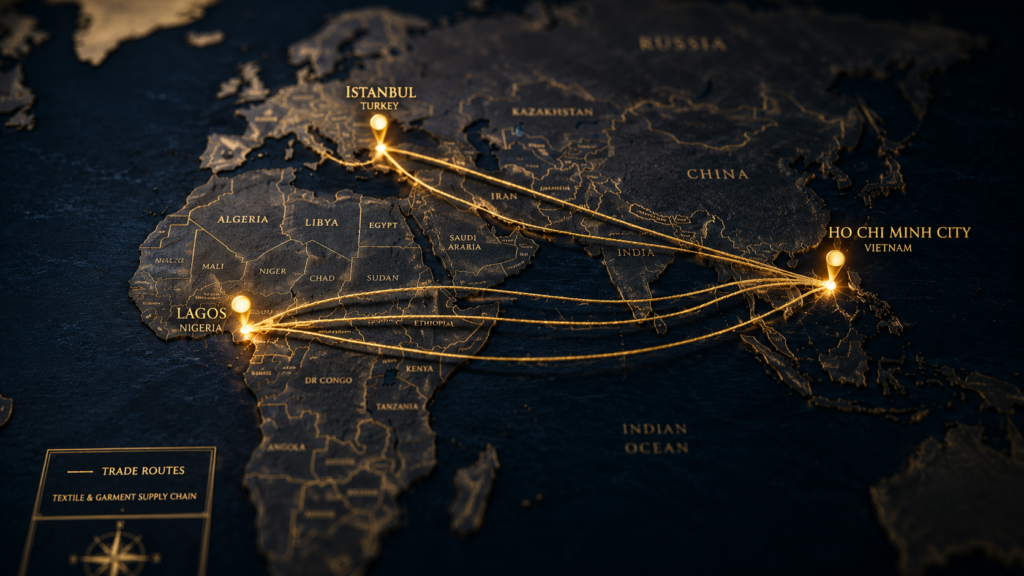
China remains the world’s factory, and for breadth, ecosystem and price it is still unbeatable across most categories. But the smart money stopped single-sourcing years ago, and two markets keep earning their place on every serious buyer’s map: Vietnam and Turkey.
Why diversification stopped being optional
Three forces, all still running: rising labour costs in China’s coastal manufacturing belts; tariff and supply-chain politics pushing global brands to “China plus one” strategies (which matured Vietnamese and Turkish supplier ecosystems fast); and freight economics — Turkey’s sea lanes to West Africa are two to three weeks shorter than East Asia’s, which is margin and cash flow, not just convenience.
Vietnam: the volume challenger
Strong in: furniture, footwear, garments, electronics assembly, agricultural products. Costs typically run below coastal China for labour-intensive goods, and quality systems have improved dramatically as global brands moved production in.
Honest weaknesses: a narrower components ecosystem than China (many inputs still ship in from China, which can stretch lead times), smaller factories with lower capacity ceilings, and sea transit to Lagos as long as China’s. Vietnam wins on cost for the right categories — not on speed.
Buyer’s note: the best Vietnamese factories are booked by Western brands; the accessible tier varies widely. Verification and factory audits matter more here, not less.
Turkey: the speed-and-quality bridge
Strong in: furniture, textiles and home goods, building materials, food-processing equipment. Quality sits close to European standards at prices meaningfully below Europe — and the sea lane to West Africa is the shortest of any major sourcing market.
Honest weaknesses: unit prices generally above China and Vietnam for comparable goods; currency volatility complicates long quotations (agree the currency and validity window explicitly); and electronics is not the strength — that remains East Asia’s game.
Buyer’s note: for hotel fit-outs, construction materials and design-led products where a 25-day lead time beats a 50-day one, Turkey’s premium frequently pays for itself in schedule alone.
What this means for your next order
- Don’t move for fashion — move for fit. Match the category to the market’s genuine strength, not to a headline about supply chains.
- Split-source where stakes are high. A main order from China with a parallel Turkish or Vietnamese supplier qualified and sampled is insurance that costs almost nothing until the day it saves you.
- Price the whole route. A 5% higher unit price with three weeks less lead time and lower financing cost often lands cheaper. Landed cost and calendar together, always.
The map is wider than it was five years ago. Buyers who treat that as a menu rather than a threat are quietly building more resilient, faster, better-margined supply chains — one qualified second source at a time.