

Your first international order fails or succeeds long before the ship sails. Almost every first-timer disaster we’ve untangled — cargo stranded at Apapa, surprise duty bills, goods that match the photos but not the need — traces back to a step skipped in the first two weeks. Here is the whole journey, in order, with the traps marked.
Stage 1 — Before you contact any supplier
- Write the specification down. Material, dimensions, voltage, certifications, packaging. “Same as the picture” is how you get the picture’s cheapest cousin.
- Estimate the landed cost first. Product + freight + insurance + duty + levies + clearance + delivery. If the maths only works at the factory price, it doesn’t work.
- Check import rules for your product. Some goods are restricted or need permits (NAFDAC registration for regulated products, SONCAP for many manufactured goods). Discovering this at the port is the expensive way.
Stage 2 — Supplier and order
- Verify before you pay — registration, licences, factory confirmation, bank-account match. (Our supplier-scam guide covers the red flags in detail.)
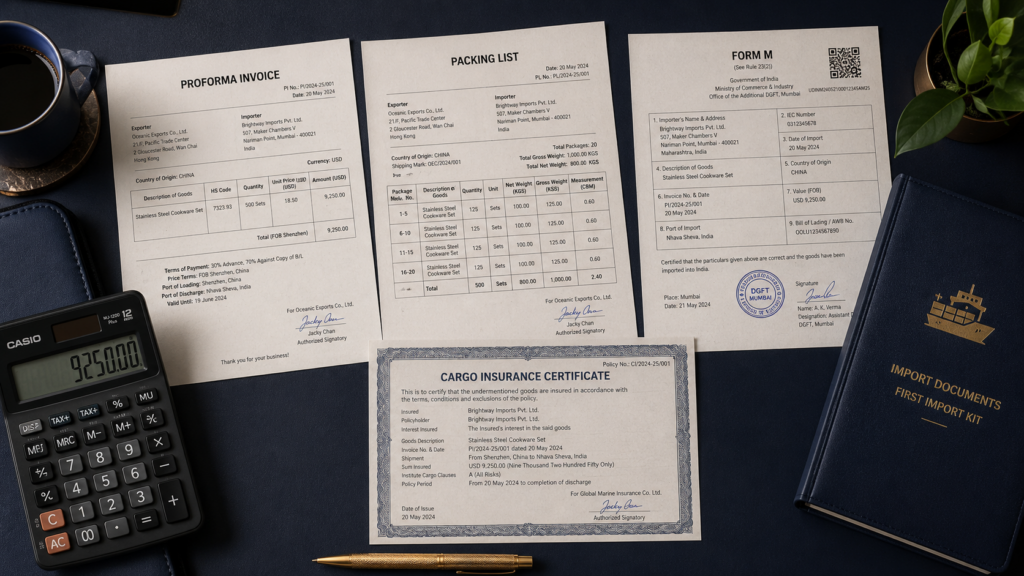
- Get a proforma invoice stating exactly what you’re buying, the trade term (FOB, CIF, EXW — learn yours), and payment terms. 30% deposit / 70% after inspection is the sane default.
- Approve a sample physically. Not photos. The sample becomes your quality benchmark for the whole order.
Stage 3 — The paperwork that makes Nigeria work
- Form M — opened through your bank on the Trade Monitoring System before shipment. No Form M, no legal clearance.
- PAAR (Pre-Arrival Assessment Report) — generated from your Form M and shipping documents; it determines your duty. Errors here are the number-one cause of port delays.
- Commercial invoice, packing list, bill of lading (or airway bill), certificate of origin, SONCAP/NAFDAC certificates where applicable. The set must agree with itself — a quantity mismatch between invoice and packing list invites a query.
- Cargo insurance. Marine insurance is cheap against the alternative. Insure for CIF value plus 10%.
Stage 4 — Shipment to your door
- Pre-shipment inspection against your approved sample. Goods that fail get fixed at the factory, where fixing is possible.
- Track the vessel, prepare for arrival. Clearance funds ready before the ship docks — demurrage charges start fast and climb daily.
- Clear, deliver, reconcile. Check quantities against the packing list at delivery, not a week later. File every document; your accountant and your next Form M will both want them.
The five most expensive first-timer mistakes
- Paying a deposit before verification.
- Skipping the sample to “save time.”
- Underestimating landed cost by forgetting levies and clearance.
- Shipping before Form M is in place.
- No pre-shipment inspection — discovering defects in Lagos, where the factory can’t fix them.
None of these steps is difficult. What they demand is sequence and patience — the discipline to not send money because the WhatsApp chat feels friendly. If you’d rather hand the sequence to people who run it weekly, that’s literally our process; if you’d rather learn it, the Import Academy exists for exactly that.