

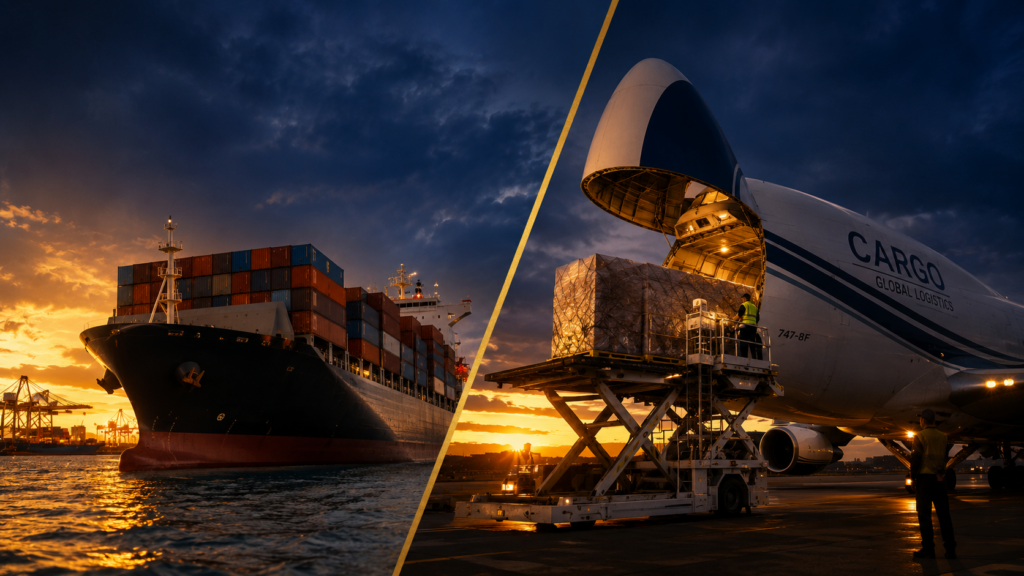
Every importer eventually memorises the trade-off: air is fast and expensive, sea is slow and cheap. True, but useless on its own — the real decision lives in the details of your cargo, your cash flow and your calendar.
The honest numbers
Typical door-to-door ranges into Lagos from the major sourcing hubs:
- Air freight: 5–10 days from East Asia, 2–5 days from Dubai or Europe. Priced per kilogram (or volumetric weight, whichever is greater).
- Sea freight: 40–55 days from China or Vietnam, 25–35 from Turkey, 18–28 from Dubai. Priced per container (FCL) or per cubic metre (LCL).
The cost gap is usually 4–6× in sea’s favour for dense cargo — and it narrows dramatically for light, bulky goods where air’s volumetric pricing punishes empty space less than a half-empty container does.
When air genuinely wins
- High value, low weight. Phones, laptops, medical electronics: freight is a rounding error on the product value, and 45 days of capital tied up at sea costs more than the air premium.
- Deadlines with teeth. A hotel opening, a tender delivery date, a stock-out on your best seller during peak season. Late sea freight can cost you the contract that paid for the goods.
- Samples and first orders. Approving a sample by sea adds six weeks to your project for no benefit.
- Perishables and pharmaceuticals with shelf-life or cold-chain limits.
When sea is the only sane answer
- Heavy and dense cargo. Tiles, machinery, furniture, building materials — air freighting a generator is how importers end up in cautionary tales.
- Predictable restocking. If you know your sales rate, the 45-day lead time is a planning input, not a problem. Order six weeks earlier; pay a quarter of the freight.
- Anything where freight exceeds ~15–20% of the goods’ value by air. That premium compounds directly into your retail price or out of your margin.
The hybrid move experienced importers use
Split the order. Air-freight the first 10–15% so you have stock to sell (or a project to start) within two weeks; put the balance on the water. You pay the air premium on a slice, not the whole order, and your cash cycle starts turning six weeks earlier. On repeat orders, a steady sea pipeline with an occasional air top-up beats either mode alone.
The decision in four questions
- What does each mode cost as a percentage of the goods’ value?
- What does 40 extra days of waiting cost you — in sales, storage or a missed deadline?
- Is the cargo dense (sea leans harder) or light and bulky (air leans closer)?
- Can you split the order and get both answers at once?
Run those four honestly and the route usually picks itself. When it doesn’t, the quotation should show you both routes priced side by side — which is exactly how we present ours.